An interesting post by railway historian Anthony Dawson on his Facebook Page ‘On Historical Lines’ titled ‘Replication, Experimentation, and Re-enactment.‘ is shown below as a screenshot, but raised a question about the operation of one railway that is already ‘lost’ despite still operating until the very end of the 20th Century, and maybe slightly into the 21st.

Bowes Railway: Rope haulage skills lost?
The standard gauge Bowes Railway in North East England is a good example of a unique railway that sadly hasn’t fared well to date in preservation despite what could have been substantial potential for it to be a ‘jewel in the crown’ of North East heritage.
It featured in the excellent film ‘Bowes Line’ by local film group Amber Films, who recorded this unique line towards the end of its working life in fantastic detail in c.1974, and a YouTube video of this is included below:
In preservation, the line has had some ups and downs to say the least!
In the early years, it managed to operate rope haulage of waggons as seen in the clip below, with the end of this being around 2000; I remember visiting the Bowes Railway as a youngster around that time and rope haulage having ceased, and unlikely to restart due to vandalism and damage to the 1950’s Metropolitan Vickers haulage engine at Blackhams Hill, as well as the more general decline of this part of the line.
This element of the railway is where the link to Anthony Dawsons comments about ‘re-enactment’ is relevant; gone are the days of the Bowes Line carrying coals to Jarrow, but until around the Millenium, it was active in operating waggons on a short stretch of the line using the 300hp electric engine at Blackhams Hill, which allowed waggons to ascend and descend two inclines.
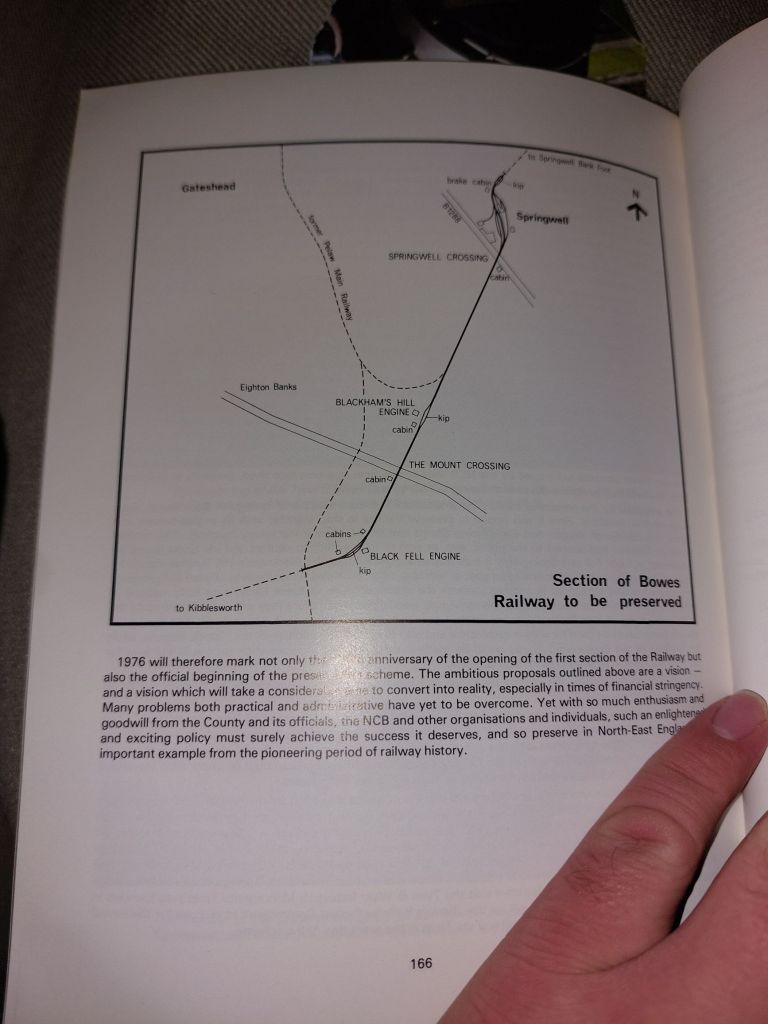
The East or Flatt Incline from the main Springwell site has a gradient of around 1 in 70 running for 1,170 yards, and was largely shared with steam locomotive operation as can be seen in the video below, with the loco deviating onto a loco hauled only section at around 3m 15s from the start of the video (the Pelaw Main Railway on the map above), with the roof of the Blackhams Hill engine house being seen immediately to the left of the loco cab.
The much steeper West or Short Bank has a gradient of 1 in 13, and in preservation has been exclusively rope worked as far as I am aware, working to the site of the Black Fell engine, which was the limits of the line in preservation, the trackbed continuing beyond Black Fell towards Kibblesworth and ultimately the Tanfield Railway at Marley Hill, which was part of the original and much larger Bowes Railway system.
Sadly with vandalism and the general decline of the Bowes Railway, the rope haulage operation ceased at around the turn of the millenium, and therefore hasn’t likely occured for over 20 years; meaning a handed down skill of operating the line has likely been lost now, and to some extent the idea of running on a wooden boardwalk to uncouple and drag a cable away from moving waggons fitted only with handbrakes is probably a big ask, even if the hauler itself was able to be restored to working condition, but probably isn’t impossible, especially on the East Incline.
Sadly the decline of the railway continued after the loss of the unique rope haulage system; with even the loco hauled trains ceasing around a decade ago as I write this in October 2026, the site remains open and available to visit by pre-arranged tours only largely on Tuesdays and Thursdays according to the Bowes Railway website https://bowesrailway.uk/
The future?
I for one would love to see the Bowes Railway thrive once again, and my thoughts on this would be as follows:
OPENING ON WEEKENDS AND HOLIDAYS
While I know it’ll not be as easy to do it as to say it, but a KEY element is getting the doors open at weekends; that is when most people have at least some spare time around work, kids are off school for families to come and visit and it is a chance to ‘sell’ the site by having the doors open, even if for just a few hours and maybe in conjunction with another attraction such as a small collection of classic cars or similar small, low cost events.
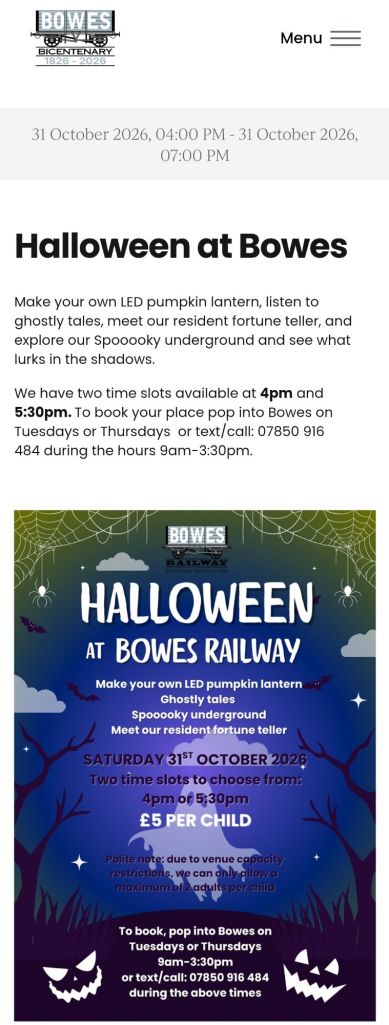
The ‘Halloween at Bowes’ event below is a great start, but booking for a weekend event should also be possible at the site on a preceding weekend, it isn’t always possible for a working parent to call in on a Tuesday or Thursday.
Even perhaps a standard ‘first Saturday or Sunday of the month’, without the need to pre-book would be a major boost to the site.
Bowes Light Railway?
A modest way to begin a passenger service could be to establish a permanent minature railway on part of the site to offer an additional attraction; a fairly standard size of 7.25in gauge would allow for regular ‘visiting’ locomotives.
As can be seen in this video from ‘Lawrie Goes Loco’ below, these miniature locos can be used in very versatile ways, and an owner/driver may well produce content for followers on YouTube or similar which markets the railway to a larger audience at a fraction of the costs of hiring in and operating a standard gauge locomotive.
There are at least three established minature railways with at least some 7.25in gauge track; Aln Valley Railway and North Tyneside Steam Railway have established 7.25in gauge miniature lines on their respective sites, as well as the Tyneside Society of Model and Experimental Engineers (TSMEE), plenty of local expertise as well as a thriving national scene for equipment and potential visiting locomotives.
This is something that could be started quite quickly on the Springwell site and would offer an additional attraction at a modest cost, and would begin getting people on site familiar with operating trains at a small scale before moving to standard gauge.
Standard gauge trains
This is probably the big ticket item, and one that is likely to be a multi-year phased operation to get restarted
Phase 1: Springwell Yard
A first phase could be to restore enough track, a locomotive and a few waggons to be able to operate within the Springwell yard things such as shunting demonstrations, and perhaps even have a steam locomotive visit for a period of time such as the summer holidays to operate around the yard, perhaps even short brake van rides with time.
To have a competent pool of staff, perhaps drawing on experienced staff & volunteers from other local heritage lines such as the Tanfield Railway, Beamish, North Tyneside and so on would be the best way forward to come for a weekend event, which has certainly happened in the past, and I’m sure many would willingly do again given the opportunity to do so.
Many years ago, many Tanfield Railway volunteers helped operate locomotives at Bowes, and since they were once part of the same railway (Marley Hill shed was built for the Bowes Railway), it is perhaps most logical to operate the Bowes Line as a satellite site to the Tanfield Railway in an operational sense, at least for a start-up period.
Phase 2: Towards The Waggon Inn and the Pelaw Main Line
I would aim high on the second phase and try to reinstate the full route of the 2011 train to the far end of the Pelaw Main route.
I would see this as a three station line; a station at the main Springwell yard, the second to the rear of The Waggon Inn pub, relocated from the awkward position of the platform on the curve near Blackhams Hill, and a final basic halt at the far end of the line where the run around loop is near Brysons animal shelter on Galloping Green Road.
If a regular passenger service can be re-established on this section of line, it would put the Bowes Railway back on the map for local attractions, and from the Galloping Green end of the line, is only a fairly modest 30 minute walk to the iconic Angel of the North.
Phase 3: Return of Rope haulage
Ideally, the rope haulage element of Bowes is what I think the railway really needs to achieve in the longer term; it is THE unique selling point of the line and would, as Dawson puts it above recreate otherwise totally lost skills.
A big barrier to this is the damage to the infrastructure from both vandalism and neglect; the winder at Blackhams Hill for example is not available to work at present, and hasn’t worked in many years, and therefore much of tbe other infrastructure is also derelict and things such as cable rollers will be deteriorating through corrosion and such due to lack of maintenance and use.
The Blackhams Hill electric engine is probably damaged beyond economic repair with it being damaged for theft of cabling and copper many years ago.
One solution to this could be to return Blackhams Hill to steam power; the current building was home to Andrew Barclay engine 7923 of 1915 until it cracked its bed plate and was replaced by the electric Metropolitan Vickers engine in 1950.
A replica steam engine like the 1915 Andrew Barclay might be a more viable alternative to a replica 1950’s electric winder; the skills needed to build, maintain and repair a stationary steam engine are largely transferable from other steam engines such as minature, road, and railway steam, which is locally fairly abundant at sites like Beamish Museum, the local heritage lines, and Ryhope Engines Museum to name but a few local examples.
As a working stationary steam engine, it would also form an attraction in itself, perhaps much more so than an electric winder would; which could allow more viability to open the building up even on non-operating days for the incline for visitors to see it. The Jack Engine at Woodhorn Museum for example, despite not being in steamable condition is still a significant attraction at the museum.
The removed remains of the 1950s Met Vic engine could be housed in a new adjacent building so that it isn’t lost or further damaged, but having a working engine at Blackhams Hill would allow rope haulage to resume, hopefully eventually on both sides of the incline and allow once again the re-enactment of rope worked waggons on Tyneside.

