While the arguments for opposing Dualling the A1 can be found here: noa1dualling.wordpress.com/, it needs balancing with alternatives, below are a few alternatives explored.
What are the alternatives?
Long Distance: Edinburgh – Newcastle or further
For long-distance freight travel, in the order of Edinburgh to Newcastle (or beyond in either/both directions) has to be using rail as much as possible; oversized or unusual loads excepted perhaps but for most general goods their isn’t much excuse that road is chosen over rail other than on costs or availability to at least match the road offering.
Costs for railfreight need to be brought to at least competitive levels with road haulage, and other factors such as on-demand and just in time delivery also need to be matched as much as possible in my view.
For passengers, again it is much the same; there is little justification for travelling such a long distance when a parallel rail route exists, except for convenience and cost.
Again, this comes down to availability and cost; passengers should have the options available to have reasonably frequent and reasonably fast services (at absolute minimum hourly) at ALL stations and that ‘fair fares’ are applied (my own view is for a ClimateTicket similar in principle to the Austrian KlimaTicket but thats for another time).
Within Northumberland
Again, this is highly linked to the above aspiration for services calling at ALL stations along the ECML; you’d run a fast, electric local train alongside the longer distance expresses.
This was PROVEN VIABLE from a feasibility study started in 2019 and reported in 2020, details available on the SENRUG website funded 49.x% each by Northumberland County Council and Northern Railway’s Seed Corn Fund with a token contribution from SENRUG funding the research.
On freight, this may be a little more challenging, as rail/road interchanges may have to be developed in strategic locations with ‘final mile(s)’ by HGV, but far better than long distance haulage on the environment.
Of the largest towns in Northumberland (14 with population over 5000 as of 2011 census figures); five are currently rail connected (Cramlington, Morpeth, Berwick, Hexham and Prudhoe), four are due to be added by the Northumberland Line project (Blyth, Ashington, Bedlington and Seaton Delaval) and five that have no immediate plans for connection. (See here for an ongoing analysis of possibilities).
These towns represent ~66% of the whole Northumberland population as at 2011 (potentially higher due to major new housing developments in many larger towns since 2011 census), and ALL could be reasonably reconnected to the rail network.
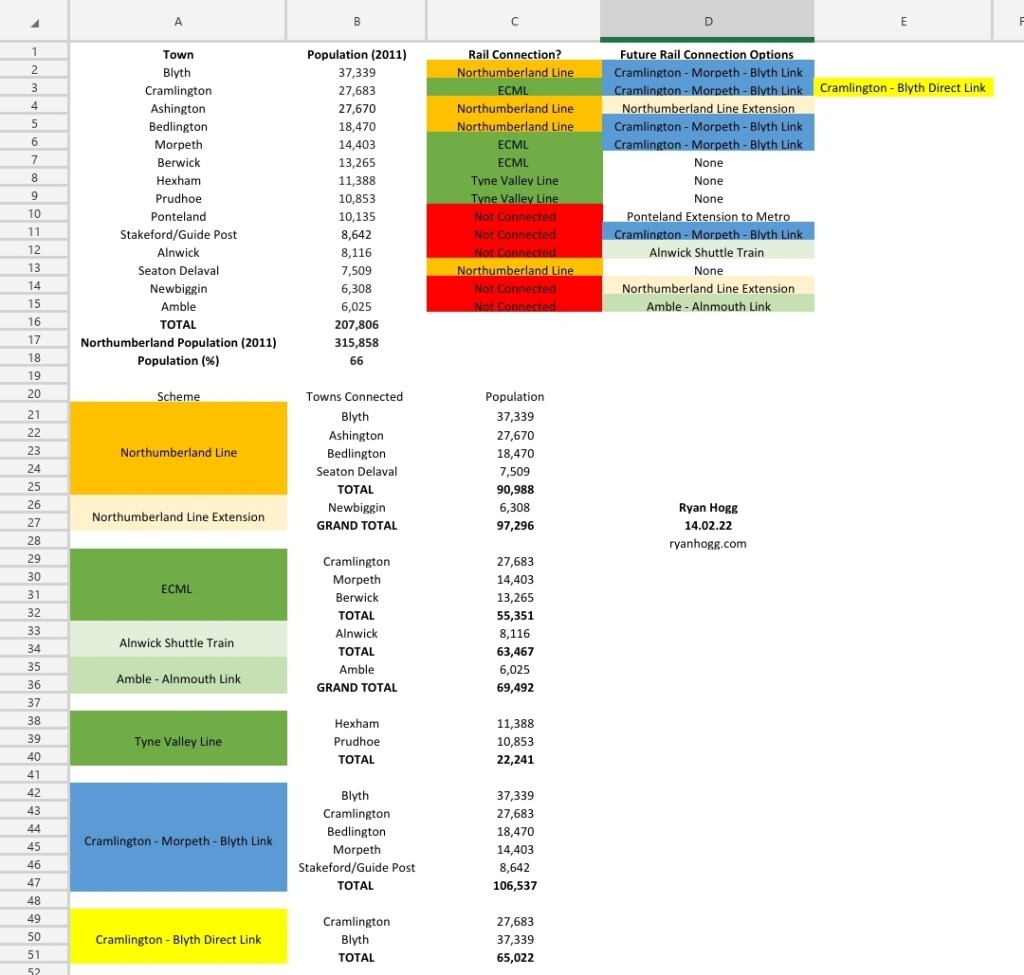
As can be seen, many are on existing passenger carrying lines (ECML, Tyne Valley) or soon to be passenger carrying (Northumberland Line).
This means that for a vast majority of Northumberland, rail travel is increasingly a viable option over road; and the currently future aspiration to reopen Morpeth – Bedlington to me makes more sense if extended to Blyth to take into account the substantial population of that town (largest in Northumberland), and allowing Morpeth station to function as an interchange for trains to/from the coast.
 Ryan Hogg