With the ongoing work to hopefully soon complete the Ashington to Newcastle ‘Northumberland Line’, it prompts the obvious question of ‘what next?’; this short page outlines my own ideas (not those of any organisations I am member of).
1. Northumberland Coast Loop
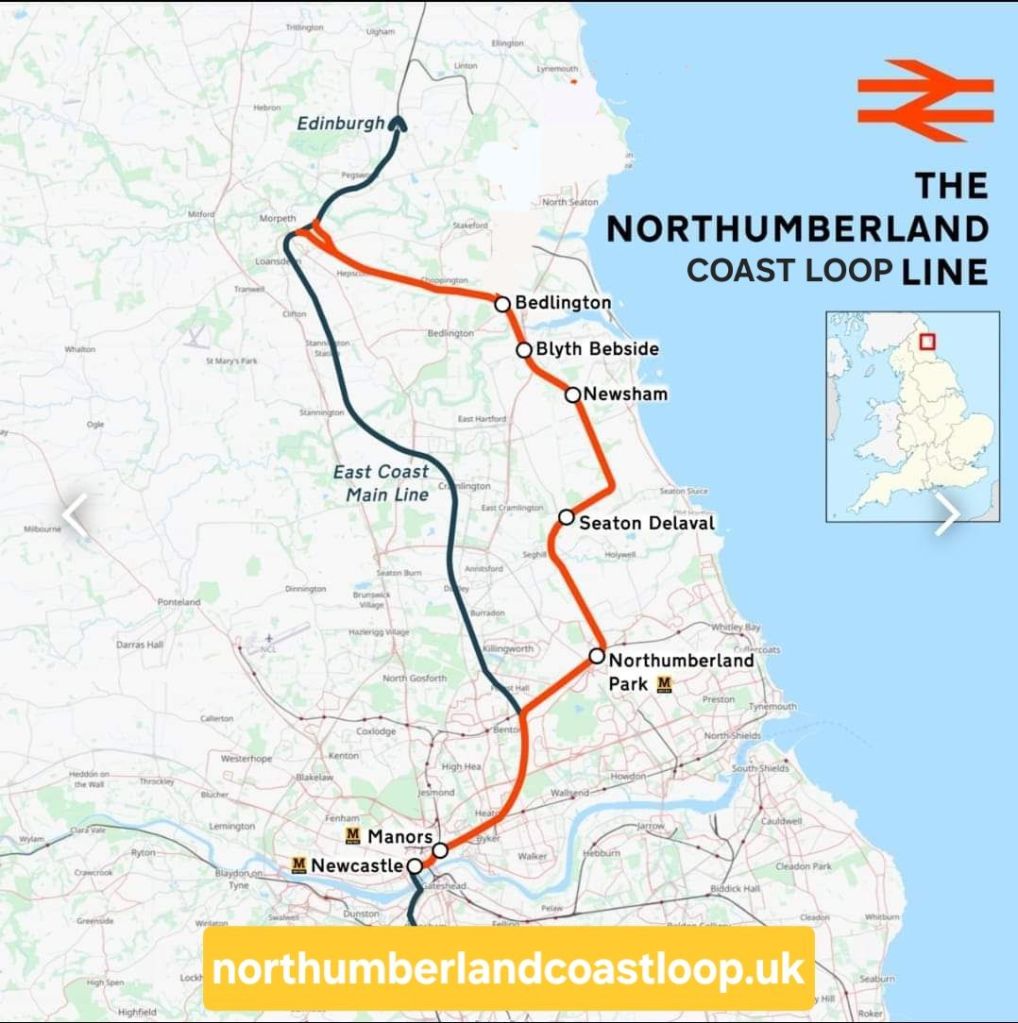
The Northumberland Coast Loop has its own dedicated page as I feel it is probably the best scheme to implement next, given it requires so little to implement (no new platforms, and simply upgrading an existing, recognised diversionary route to regular passenger running).
In quick summary, this route would simply share the Northumberland Line between Newcastle and Bedlington, with trains to some/all stations along it, then use the existing Hepscott Line to connect back to the East Coast Main Line (ECML), ideally headed northwards, to provide a link between SE Northumberland, North Northumberland, and Scotland. It would use platforms either already in place (i.e. those on the ECML), or those being built as part of the Northumberland Line project, all it requires is regular passenger trains over the ~5 miles of line between Morpeth North Junction and Bedlington.
2. Newcastle to Lynemouth via Woodhorn
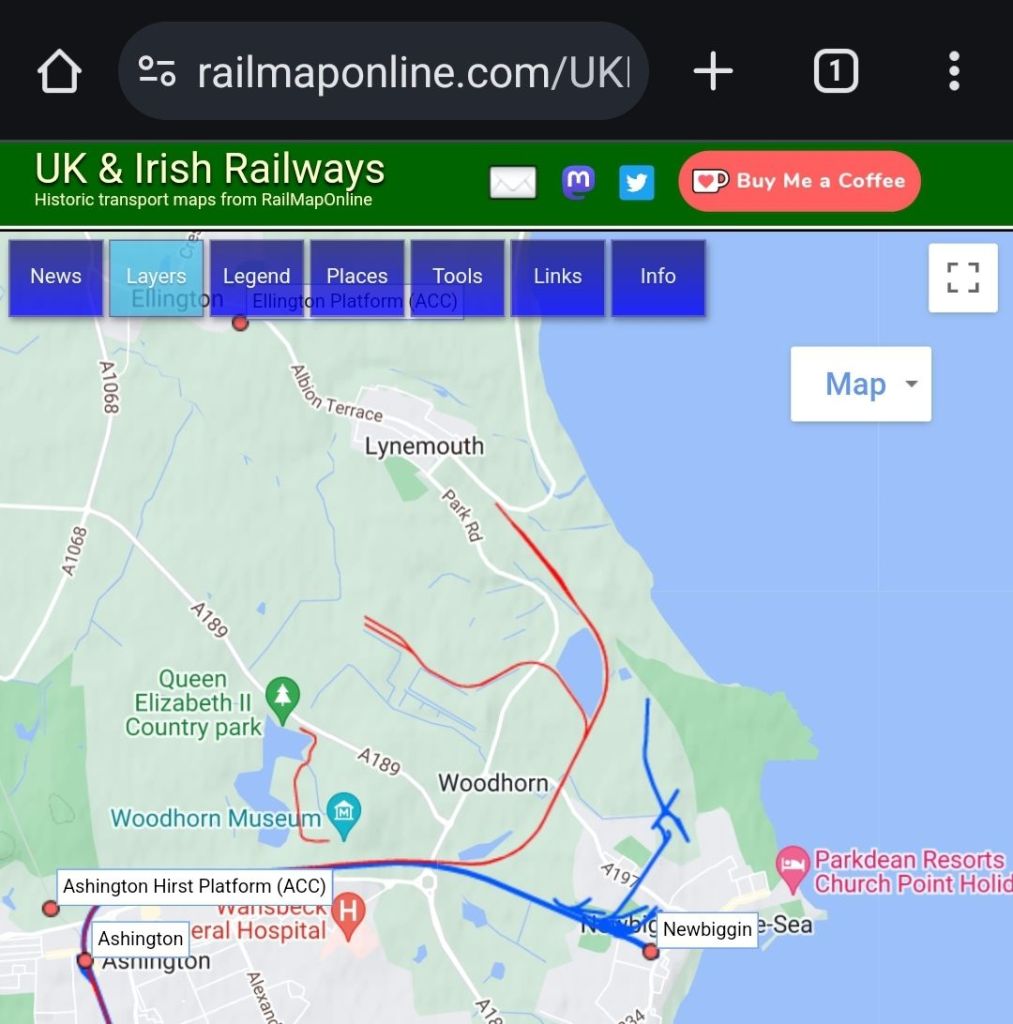
With track already in place as far as Lynemouth Power Station beyond Ashington, this route is perhaps the ideal ‘end on’ extension of the Northumberland Line to the village of Lynemouth (also serving Ellington), with potentially a very short extension of the headshunt at Lynemouth Power enabling a station close or even adjacent to the Lynemouth Miners Welfare Institute, Bridge Road, Lynemouth (NE61 5YJ).
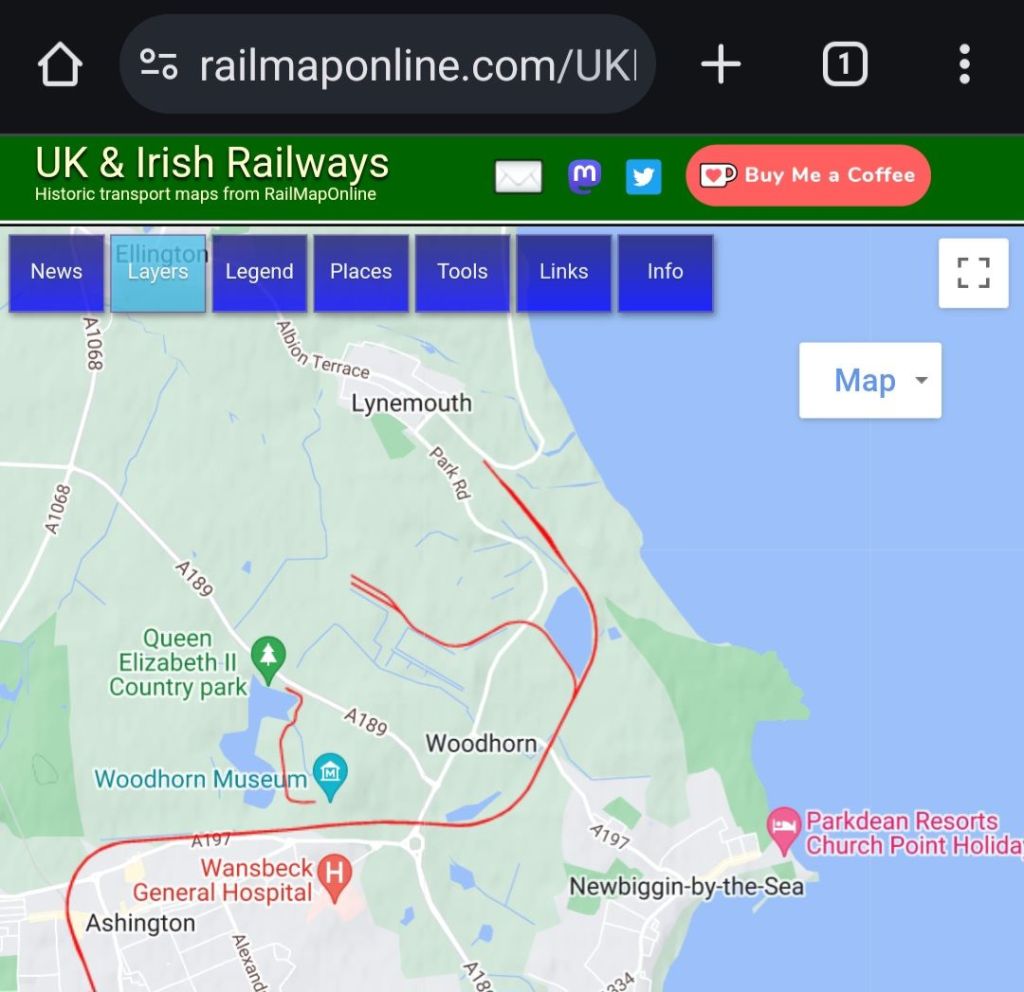
This route would take the line north and east of Ashington station, passing near to Woodhorn Museum and over the A189 (Woodhorn Station site proposed here and identified on local plans), but rather than building the short branch into Newbiggin itself (only approx 0.8mi in length), the line would instead continue approx 2.2mi to Lynemouth (Bridge Road).
While historically Newbiggin did have a station within the town, development since closure means that the line would be likely to be truncated back from its original site, and if built could mean a splitting of service between Lynemouth and Newbiggin, but given the close proximity of the line, an additional station next to the former St Mary’s Church at Woodhorn (A197 passing below railway) might be a better option over building a very short branch line.
This service would simply be an extension of the soon to start Northumberland Line service so pathing would be similar if not near identical to present, but a longer route might require additional trains/crews.
Blyth Bebside as a hub between ‘core’ and ‘captive’ services.
The Northumberland Coast Loop (N.C.L.), and the Ashington/Lynemouth Branch would be envisaged to be the ‘core’ routes along the line, both providing direct links into Newcastle, and especially for the N.C.L. also direct connections northward.
Blyth Bebside has been selected as the ideal for a local hub due to its strategic location serving Blyth, but also excellent links to Cramlington, Bedlington, Ashington and wider area via rail, bus and road transport (at crossroads of A189 and A193), and unlike Bedlington could offer opportunity for longer platforms to be built, allowing for long distance trains to call there.
The following two connections (Morpeth (Bay) and North Blyth), would likely remain ‘captive’ within the local area, with Blyth Bebside station especially, but Bedlington and potentially Newsham additionally acting as interchanges with the ‘core’ services to/from Newcastle, Berwick and beyond.
This is due to potential limitations on line capacity south of Newsham, where long stretches of the Northumberland Line are single track, which reduces capacity, as well as limited capacity on the ECML between Benton Junction and Newcastle Central Station.
To remain ‘captive’ on the network, would require services to terminate at Blyth Bebside or Newsham in a dedicated turnback platform or siding before reversing, similar to how trains operate at places like Battersby on the Esk Valley Line to Whitby.
This could also offer an opportunity for a through route from Morpeth (Bay) to North Blyth via Bebside/Newsham, and perhaps consideration could be given to a balloon loop as opposed to a bay platform or siding, allowing for a reversal without the driver needing to change ends, which would also be potentially advantageous for rail freight/loco hauled trains too, compared to using the sidings at Bedlington.
3. Blyth Bebside/Newsham to North Blyth (for Blyth)
While the Northumberland Line will give the large conurbation of ‘Blyth’ two stations (Blyth Bebside, and Newsham, on slightly southward relocations for both), Bebside is on the western edge of town, and Newsham on the southern edge. There is, therefore, quite a valid point that the traditional centre of Blyth next to the busy Port of Blyth is still quite some distance away, and given the challenges of heavy road traffic within the town may need further rail connectivity to the northern and eastern edges of town.
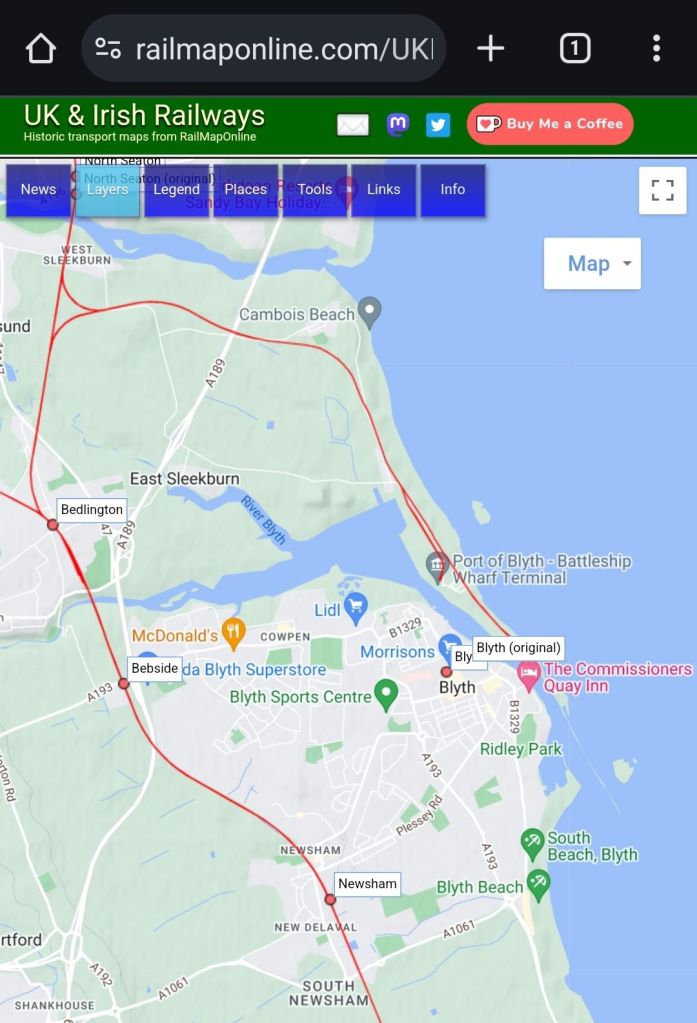
As can be seen from the map above, the Cambois Branch arcs around the north of Blyth, serving industrial sites such as Battleship Wharf, but it is only a short distance from the original Blyth station, albeit separated by the River Blyth and its active port.
Establishing a connection across the River Blyth (probably an electric chain ferry similar to this one shown by YouTuber Tom Scott), could allow for access to a new station at North Blyth, established on this industrial branch from the Northumberland Line. This could also tie into investment in Cambois made by Blackstone, who propose up to a £10bn investment into the former Blyth Power Station site, and a ferry connection could offer relief for the very congested road routes within Blyth by providing a north eastern route to and from the town centre.
This route also has the advantage of passing through Bedlington and Blyth Bebside stations compared to the original route, which would offer better connectivity from these stations too.
This could either be done via an alternative conventional rail route (i.e. Northern or similar), or an extension of the Tyne and Wear Metro to the site (possibly using battery vehicles).
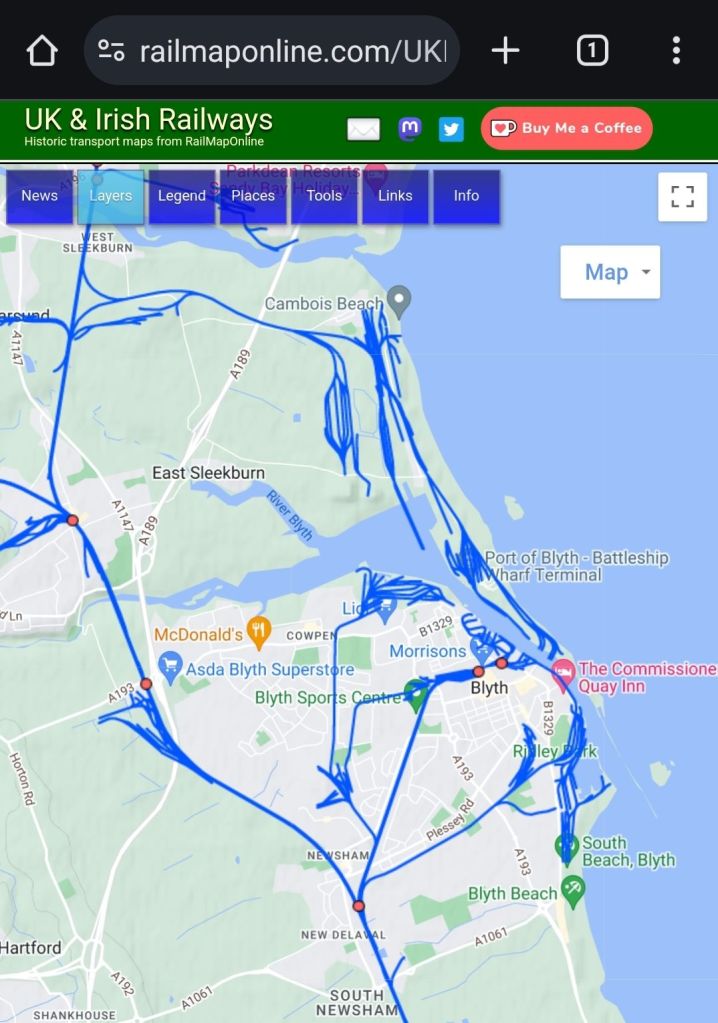
The reasons for not pursuing a rebuild of routes into Blyth, as was there before is, like Newbiggin due to development after closure of the route, with a hospital, leisure centre and a new school (Gilbert Ward Academy) being built on the route to the original station, with additional issues from a low bridge (now removed) over Princess Louise Road, and several disused level crossings, particularly the busy Plessey Road crossing which is just after the junction with the Northumberland Line. In general, the ORR and Network Rail seek to close level crossings where practicable, so rebuilding a one in a busy urban setting isn’t likely to be easy to do and given the truncated nature of the branch would probably give fairly low advantage compared to using existing Cambois branch and re-established ferry connection over the river.
4. Blyth Bebside/Newsham to Morpeth (Bay Platform/Coopies Lane) via Bedlington
At present, there is a regular (approx hourly) service between Newcastle and Morpeth via Cramlington, which is proposed for extension on to Bedlington once Bedlington station is opened.
While this is a good idea to use up the considerable idle time of trains standing in the sidings at Morpeth; the fairly low frequency of the service (hourly), compared to every 30mins on the Northumberland Line, and only running as far as Bedlington could ideally be improved.
With the intensive nature of ECML services, it is unlikely that a 30minute service could be operated, especially as paths could ideally be reallocated for longer distance services to North Northumberland/Scotland. One solution could be to terminate services at Morpeth coming from the east in a separate platform, maintaining or even improving capacity on the ECML, whilst also improving connectivity to larger towns such as Blyth.
To do this would require either reopening of the former ‘Blyth and Tyne’ bay platform at Morpeth, presently occupied by the Northern car park adjacent to the southbound platform, or perhaps less ideally in the nearby Coopies Lane industrial estate. This was something suggested several years ago in A Third Platform for Morpeth.
This would keep trains terminating at Morpeth clear of the mainline, and allow a greater number of services to call there to/from the east, boosting the number of connections available and making Morpeth back into a major junction station once again.
Such a service could, as suggested earlier be operated as a longer, singular east-west route from Morpeth to North Blyth if reversal was undertaken while carrying passengers (as done at Battersby).
Please let me know what you think in comments below or via social media. RH.
 Ryan Hogg