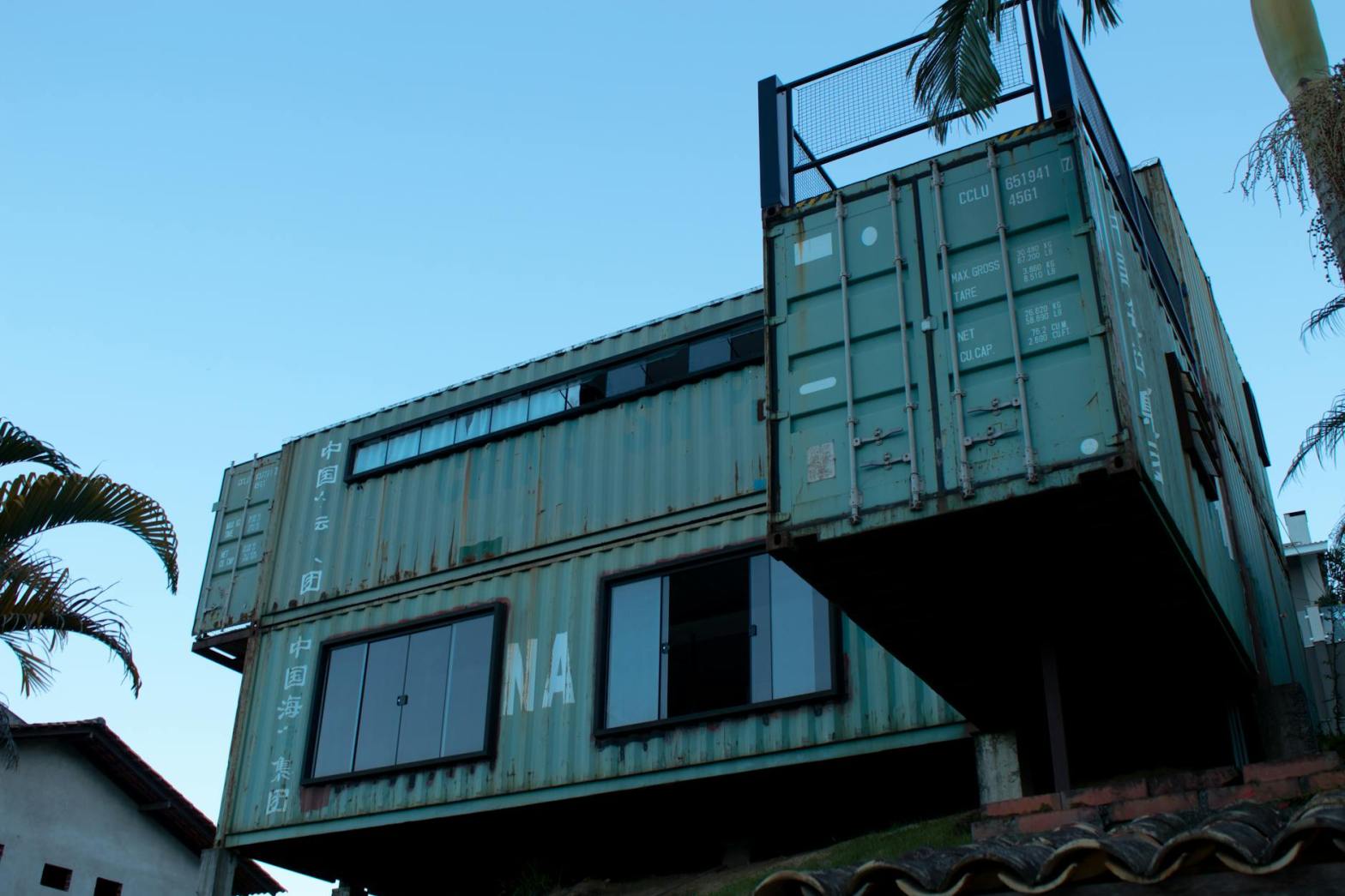
Could a revival of railway camping holidays in a modern ‘railboat’ be a way of solving a number of issues on the rail network by using resources more effectively?
A recent discovery on YouTube was a shipping container conversion into an easily transportable ‘Glamtainer‘, which in the video was loaded aboard a sideloader HGV (examples of these can be seen on the Containerlift website).
It does raise the question though, could such container conversions be an option to modernise the ‘camping carriage’ concept, and allow accomodation at railway stations and sidings be able to return in a more adaptable and flexible format than seen previously?
This option could be highly modular and adaptive to requirements, for example two separate 20ft accomodation units could easily be swapped for a single 40ft one if required, and combinations of decking units could be employed; for example a very plain open deck with a safety fence could be exchanged for a roofed canopy style one, or perhaps even one furnished with a hot tub?
This could allow a huge potential range of options; from a single ‘unit’ of one waggon set-up as a mobile camping container, to an entire block train being used for a ‘mobile village’ of units depending on demand.
The waggon with ‘double g’ is an archaic term in the north of England for a railway waggon, as opposed to a road wagon, and is used here to help maintain clarity of referring to rail vehicle rather than a road one.
This would also mean that when out of season, these converted shipping containers and other modular elements could be offloaded and the waggons returned into normal railfreight use, or for waggons nearing the end of their useful working life, a largely static use in a scenic spot could be a way of providing some continued revenue from them ahead of being scrapped?
The limitations of width, height and length are similar, but slightly more generous than narrowboats, which a popular choice of holiday in the UK on the canal network; and could allow the potential description of a ‘railboat’ to describe this concept of mobile accomodation on rails. The resurgence of the canal network has been bolstered by the boating holiday, could the same be done on rail?
A key difference between ‘railboating’ and narrowboating, is the unlikely ability to be able to remain within the accomodation whilst it is moving; but given that many people moor long term in marina, and stay aboard, and many caravanners have semi-permanent pitches or static caravans rather than regularly touring, this is likely not a deciding factor, and therefore the inability to move the accomodation themselves (again common with static caravans) is also not a limiting factor.
A wider network of sleeper trains could work alongside this proposal, but requires a large fleet of new dedicated rolling stock, whereas this option is based on modular units (converted shipping containers), being placed on existing and ageing intermodal flats, meaning a use of relatively low cost existing options being simply combined together), the conversion of old carriages into accomodation is similarly a much larger potential capital outlay, though it has been done successfully in a number of places and could be option too.
Container Conversion: Staying inside ‘The Box’
To reduce complexity, and avoid having an extendable element, a fixed size container could be used, as in this ‘container village’ comprised of four 20ft shipping containers, which also retain the end doors, allowing the container to be easily secured for against the weather (as these were in a fixed position), but could be similarly used during transport to ensure that patio doors etc were protected from branches/flying debris.
The covering of side doors, and end windows could be done using shutters, as seen commonly on site office containers, but done in a more aesthetically pleasing manner whilst retaining their security and safety benefits during transport or storage, and if in a long-term position might be entirely removed from the vehicles themselves.

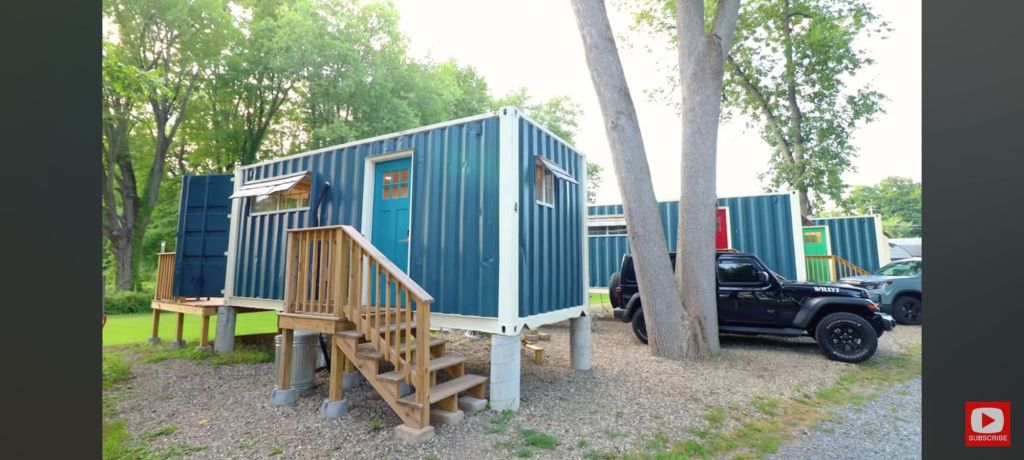
Having a non-extending container would keep things simple, basically a box being put on wheels, and just needing alignment with a flight of steps or a platform to gain access to/from the vehicle, but it should surely be possible to have different combinations of modules working together, for example a shallow ‘decking’ unit could be placed adjacent to the patio door end of a accomodation container with an appropriate infill section to avoid a gap between the two pieces once placed on a waggon.
These modular components would, almost needless to stay, have to be of a robust design for transport by rail, perhaps using more robust materials such as steel for handrails rather than timber, but could be done in a suitably stylish way, or perhaps could have some timber elements such as handrails.
The containers themselves could also have wide range of features, some might be ‘plug and play’, in that once on-site, could be plugged into mains electricity, water, sewerage etc, but the option of a ‘standalone’ unit using a battery/solar panel/generator combination with fresh water and grey/black water tank (showers, sinks, toilets etc) requiring fill-up/emptying before and after travel to site, but this is quite common in narrowboating, and isn’t a huge leap for a rail waggon based accomodation to use similar systems.
Similarly, heating systems such as oil based heating, or a wood-burning stove would allow for an ‘off-grid’ unit that could be placed in very remote locations if required and not need provision of utilities.
Staying ‘On the Waggon’

As can be seen above, a 60ft waggon can accomodate multiple different container sizes, and therefore potentially different combinations of accomodation, decking etc., with the photo below (from LTSV Rail Data) showing 3x 20ft containers being loaded on a similar waggon (FEA-E) which could correspond to 3 accomodation units in a high density format, however, a split decking unit (20ft split into two sections, perhaps with an opaque screen) could be placed where the green container is positioned, giving two accomodation units with outdoor space on-board.
Another combination would be a 40ft container conversion plus a single 20ft deck unit or another accomodation unit, showing the potential versatility of these waggons.

As stated earlier, an ideal candidate waggon for this use could be older, nearing end of life vehicles, where a largely static existence would offer a potential life extension, whilst still earning some revenue towards their upkeep, especially as even when in motion, an accomodation unit is likely to weigh much less than a fully loaded freight container, contributing to lower wear and tear.
Potentially like other comparatively modern rolling stock such as Pacers, these older intermodal flats could be purchased by heritage lines and put to use as the chassis for an accommodation unit on wheels for much lower cost than carriage conversion, especially when carriages, especially older ones are becoming a premium resource due to increasing age and relative rarity.
One option could be for railways seeking to extend their running line to place accomodation units such as this in strategic places, earning a revenue, whilst also advertising ‘the railway is coming’, and being on wheels, can be easily jostled around to make room for more vehicles, or to be moved as and when the line is needed for conventional trains?
Potential Market
This type of accomodation is likely to appeal to a broad base of people; the ‘glamping’ element of comfortable accomodation will have a wide appeal, with something of a novelty factor by being on rails, even for those without a particular interest in rail as a subject.
Many UK railways are sited in extremely scenic landscapes, and are often ones that also have restrictions on development of permanent accomodation, such as hotels, or even caravan sites, whilst the railway may have existing and often underused sidings, which might be ideally suited to such uses, and might help retain them for future use.
For example, the old sidings at Belford Quarry, near Belford in Northumberland could be an ideal spot to revive rail use of the site pending a reopening of the quarry? Similar locations exist across the UK, and may provide a opportunity to retain and maybe even reopen railheads in rural areas by giving them a stable source of income from tourism.
Another example could be to revive a stub of an old branch line, such as at Garsdale on the old route to Hawes, which would contribute to the use of Garsdale Station for people travelling to/from accomodation, and ultimately to reinstating the Wensleydale Railway fully, but could work alongside plans for an active travel route in parallel, as people would need to walk/cycle to and from their accomodation, which to me would be a sensible way to help deliver both the reopening of the railway & an adjacent railway path, as proposed recently in this BBC article.
On the latter point, I fully support the idea of reusing disused railways as active travel corridors where this is appropriate to do so, but I also strongly feel that these should not impinge on the ability to reuse a trackbed in future if it is required. we should be able to build new active travel routes where these are needed, and not be blinkered to just using old railways or road routes.
An important caveat is that not all disused railways will be rebuilt ‘as they were’, so some railways, or some sections will never be reused. I am very much in agreement with the point made by Gareth Dennis, rail engineer, creator of his excellent Railnatter series, and author of ‘How the Railways Will Fix the Future’, that whilst we MIGHT reuse some trackbeds, we need to look at NEW railways, not just reopening old ones, similar to how we don’t just reopen old roads back up, we build new roads that might use some old alignment in the process.
In short, a renewal of the camping carriage in the 21st century might just be part of the way to drawing extra revenue, retaining, and rebuilding infrastructure, and enhancing the active travel network in parallel to it.
 Ryan Hogg