This recent video about Trams by the excellent Not Just Bikes channel on YouTube discusses the vast array of benefits to be had by expansion, and in the case of Newcastle and the wider Tyneside area their reintroduction of tram systems.
In this thought piece, perhaps it is time Tyneside to bring back its tram network, but with modern vehicles, not the bygone boneshakers of Beamish.
The Trams of Tyneside Past
A recreation of the tram systems of the past around Tyneside, Gateshead, and Sunderland live on in the nearby Beamish Museum. Sometimes referred to as ‘boneshakers’, these early trams still represented a great way of moving people quickly and cleanly (100% electric for more than 100 years!). Beamish Museum is actually a good way to see how effective they are at moving people around the vast museum site, the trams, despite their vintage don’t take long to move substantial volumes of people.
Beamish is also actually a great example of how, as little as 100 years ago, the car was largely the plaything of the rich, with this article by Carlton Reid suggesting that in 1923 (the year of the railway grouping to form the LNER, LMS, GWR and Southern Railways), there were just 383,525, but just seven years later in 1930, that number topped one million, and two million just before WW2.
Even by the 1950’s, licenced vehicles were still not hugely commonplace, with about four million on the road, according to UK Government statistics, rising to about 34 million by 2010.
The RAC Foundation states that as of June 2024, the UK now has 41.7m vehicles on the roads, made up of 33.93m cars, 4.8m large goods vehicles, 540,000 heavy goods vehicles, 1.47m motorbikes, 140,000 buses and coaches and 870,000 in ‘other’ categories.
The growth of private motoring and road freight, as well as a more general decline of heavy industries such as mining, ship building etc has meant that systems such as railways and trams have declined during the 20th Century, especially post-WW2, bit signs of change were beginning in the interwar period as some early railway and tramway closures occured during this period.
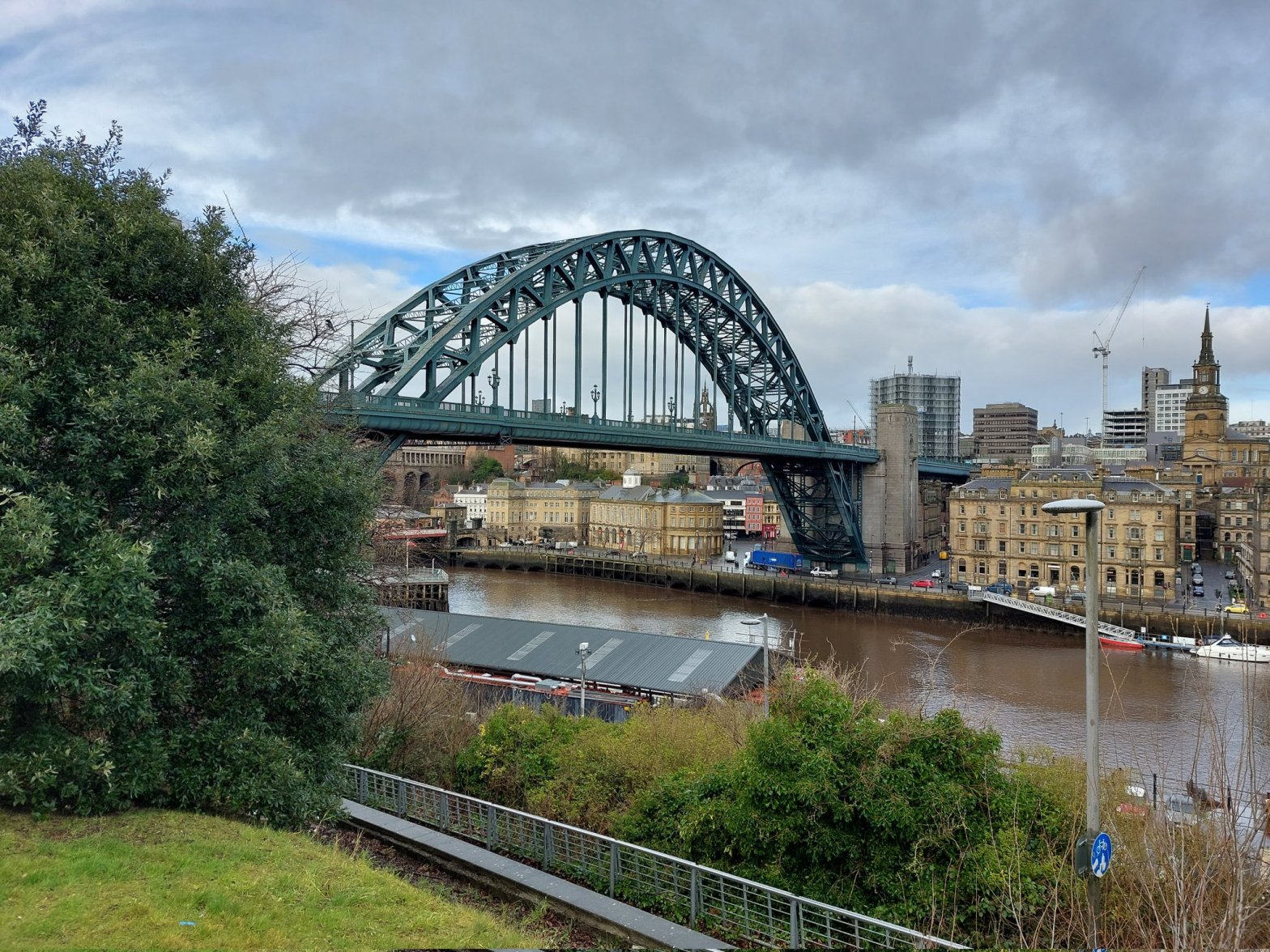
At its zenith ,the tram network of Tyneside (Newcastle and Gateshead), as well as that of Wearside (Sunderland and surrounding area) was very extensive, with 51 miles of route according to the Wikipedia page for just Newcastle Corporation, Gateshead and District Tramways had around 12 miles, with both systems interconnected over the High Level Bridge and 1928 Tyne Bridge. Further systems north of the Tyne were the Tyneside Tramways and Tramroads Company with just shy of 11 miles, and Tynemouth and District Electric Traction Company with 4.2 miles.
On Wearside, Sunderland Corporation Tramways had 12 miles of route, Sunderland District Electric Tramways a further 14 miles of route.
Further systems such as South Shields Corporation Tramways had 7.5 miles of route, Jarrow and District Electric Tramway with 2.5 miles show the extensive reach of these systems prior to the 1950’s when most of these systems were closed; the above list not an exhaustive one, and actively excluding the planned but unbuilt tramways that potentially would have reached places such as Blyth, Bedlington and Ashington.
These networks existed in some degree of competition with other transport systems, for example the Tyneside Electric Railway system (now forming a large part of the Tyne and Wear Metro) was a direct competitor, indeed electrification of the railway was provoked by the competition from trams.
Sadly during the 1950’s, the tram network was entirely dismantled, followed shortly afterwards by the reduction in the local rail network, with closures of stations and routes, leaving a skeleton of what once existed.
Fortunately, closures of many other lines were averted, as during the 1970’s, the closure of lines like the Tyne Valley Line and ECML north of Newcastle was mooted as a possibility, now such a closure would be almost unthinkable, undoing some of the passenger closures has been done already by reopening lines such as the Northumberland Line in December 2024, but should trams return to Tyneside too?
Present Day Tyneside Transport
Transport on Tyneside is now focussed on three key public transport modes, the first is the conventional rail services such as those operated by Northern along the ECML to Morpeth, the Tyne Valley Line towards Carlisle, the Durham Coast Line to Sunderland and Teesside, and recently joined by the Northumberland Line to Ashington.
Second is the Tyne and Wear Metro running the green line from Airport to South Hylton, and the yellow line from St. James Park to South Shields, built mostly on the former Tyneside Electric Railway routes around North and South Tyneside, with the addition of the Sunderland & South Hylton stretch.
The third and final major public transport system is the bus network, which reaches many of the places that trains and Metro can’t reach.
Trams on Tyneside in the 21st Century?
There are many places in and around Tyneside where conventional rail or the Tyne and Wear Metro is unlikely to reach, but buses are not an ideal fix, but perhaps a tram network could be a solution.
For example, routes like Scotswood Road could help make the west end of Newcastle into a rail served area, perhaps using parts of old railway infrastructure, but also on-street running to provide better public transport to areas such as Newburn, Lemington and Scotswood, and provide a link right into the heart of Newcastle.
It is unlikely that conventional trains or the T&W Metro will ever again run on the north bank of the Tyne towards Newburn, but a tram could, similarly large sections of Gateshead are unlikely to ever see T&W Metro services or mainline rail services, but trams could infill the gaps.
Trams reach the Angel of the North, if the will was there to build the network out there.
Even in areas where rail and T&W Metro already provide a good level of service (for example Central Newcastle and Sunderland), trams could be a valuable addition alongside, for example a tram from Central Station, then along the edge of the Town Moor (Great North Road) into Gosforth High Street, could then connect to places off the Metro such as Newcastle Racecourse, Hazelrigg, Wideopen and Great Park.
Indeed extending the above route to Cramlington, serving areas such as Northumberlandia, and Nelson Park Industrial Estate could prove highly worthwhile and augment heavily used bus routes.
Similarly, a route parallel to the A1058 Coast Road could capture many places quite distant from Metro and railway stations. There are many possibilities which would need further research to fully identify but it could be a worthwhile system to reintroduce to Newcastle.
Tram-train units, as used in Sheffield, are perhaps a near ideal solution, as the Class 399 can operate both on-street and on railway, meaning a short on-street tram section could be branched off a mainline, for example in the Team Valley, a tram could run on-street along Kingsway, right down the middle of Team Valley, and then join the Tyne Valley Line near the A184, to then access MetroCentre, and via a new river crossing, could then connect over into Scotswood and beyond. South beyond Team Valley, a tram route could extend towards Chester-Le-Street, and maybe even into the City of Durham, and perhaps even places like Consett and Beamish Museum might see modern trams?
All thoughts above are my own, and do not represent any other organisations or groups.
 Ryan Hogg