
Northumberland is really starting to feel the pressures of a predominantly car-based transport system, with the gridlock in Blyth and Felton being used as a rat-run to avoid traffic on the A1.
Congestion Charging in Northumberland?
While it might be a controversial suggestion, perhaps is now the time to consider congestion charging on some of the busiest routes in Blyth, as well as roads through villages and towns being used to ‘rat-run’ around other congestion hotspots such as Felton is by the recent article.
This option would certainly discourage driving at peak times (assuming charging was higher/only at peak travel times), and for villages such as Felton, the presence of a congestion charge at all would discourage through traffic completely.
A scheme similar to that employed in Durham would likely be the ideal, a daily charge in region of £4 as per the Durham system is not unreasonable, and residents/businesses could have similar exemptions (allowing up to five cars per household/two per business to be registered as exempt from the charge).
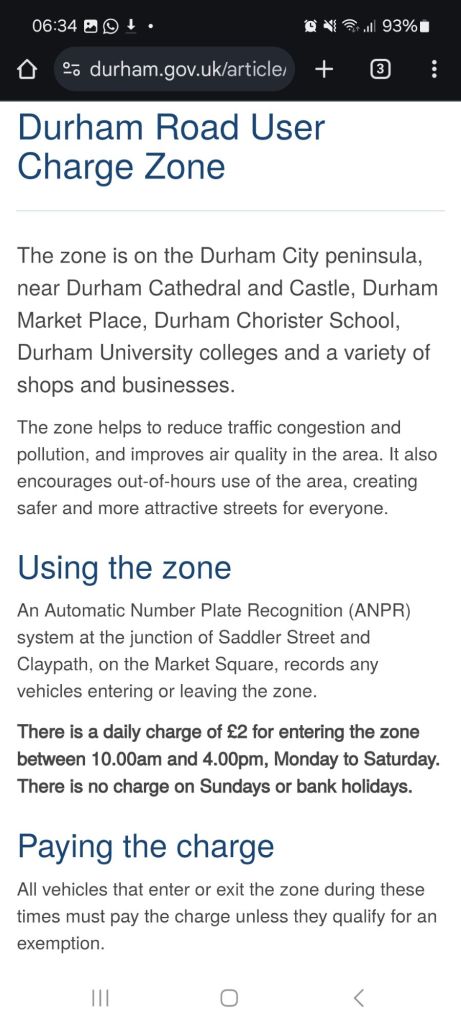
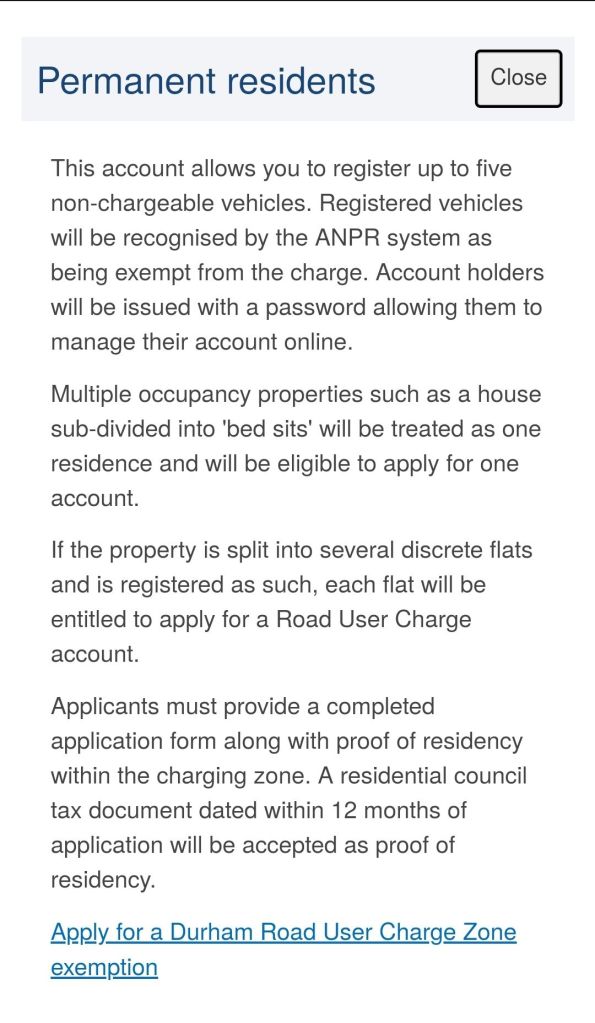
In my view, using a system such as this is a way to discourage driving in the most congested places, and for essential traffic such as that to/from businesses, the trade-off in paying a congestion charge could easily be mitigated by vehicles not sitting in traffic. For a town such as Blyth, the option would remain to allow one free route alongside one paid route, so people could have an option between both, and if it doesn’t work, it can always be withdrawn, but where implemented, it is usually successful by finding a better balance of road traffic.
Blyth Relief Road – A Road to Ruin?
Blyth is a town constrained by its geographical position, the River Blyth forms a natural limit along its northern edge, then curves southward as the Port of Blyth to empty into the North Sea near to South Beach, thus the town could be said to border on two of its four sides with water, meaning any approach by land can only be to/from the east or the south. With just three major land routes into Blyth via Cowpen, Newsham, or South Beach.
Blyth has had traffic problems as long as I can remember (I was born in 90’s), and there has already been significant work to try and ‘reduce congestion’, with £750,000 being spent on Cowpen Road alone back in 2016 to remove some sets of traffic lights at the Tynedale Drive/Cowpen Road junction and some further work on Cowpen Road to attempt to smooth traffic flow.
I think it would be safe to say that any advantage that £750,000 scheme had in reducing congestion is now fully used up at time of writing this in November 2024, so a £750,000 investment only lasted at best eight years, meaning an approximate cost per year of benefit of £93,750 at best.
The problem with these alleged ‘solutions’ to congestion is that they are only temporary and fleeting; as soon as traffic flows more easily, more people start driving and gridlock quickly returns.
This is why a congestion charge, as mentioned above is the only likely solution to solve road congestion in a town such as Blyth.

The image above examplies the problem quite neatly and succinctly of what happens at Cowpen Road, where four/five lanes of traffic (two each direction on A189 plus Front Street in Bebside) are reduced to a single lane of traffic into Blyth itself along Cowpen Road.
You could widen the A189 to a three lane Motorway (the A188(M) perhaps?), and all it would do is worsen the traffic problems as even more traffic would be attempting to flow through the bottleneck into the town.
Which is where the ruinous relief road comes in; dualling a road like Laverock Hall is going allow even more traffic to swamp roads like South Newsham Road (B1523), Rotary Way (A193) and Links Road (B1329). Increasing traffic on these already busy roads will make them more dangerous, which will push more people into cars rather than walking/cycling and simply drive more gridlock.
As stated at the top of the blog, the only real fix will be reducing the existing levels of traffic, which could be achieved via a congestion charging scheme (which could be more widely spread across many Northumberland Towns that have problematic traffic, not just Blyth and Felton, but also places like Morpeth, Bedlington, Alnwick and more).
Relief Road the wrong fix, what else could be done?
So the Relief Road shouldn’t, in my view, be built at all; it won’t ‘relieve’ anything, and is likely to simply exacerbate existing problems, but people need mobility, so what are the fixes?
The Northumberland Line should go a long way to alleviating the traffic when Newsham Station opens in early 2025, and especially once Blyth Bebside also is open later in 2025. The stations are part of the real fix for Blyth’s traffic woes – get people out of cars completely where you can.
As stated, this is only a partial solution, Blyth is the largest town in Northumberland, and the Northumberland Line skirts its western and southern edges, rather than being more centrally located as in Ashington; there are further fixes needed.
The River Blyth: Problem & Ferry Easy Fix?
As stated at the start, the River Blyth and Port of Blyth form a northern and eastern ‘barrier’ for land traffic going out of Blyth, but turning this problem around, a ‘Port’ means a river open to navigation, so why not use the river to also partially solve the problems?
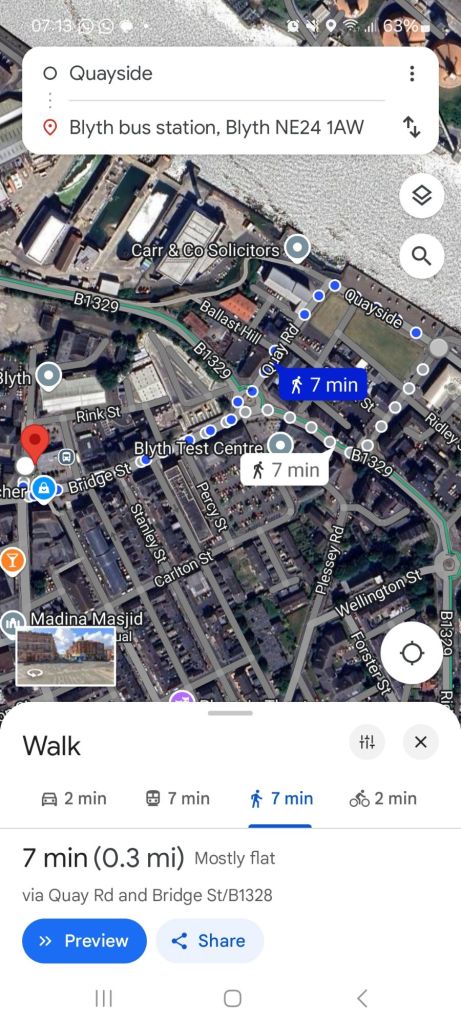
The distance from Blyth Town Centre (taken as Blyth Bus Station for consistency) to the Quayside (where ships such as Galleon Andalucía frequently dock and allow access) is pretty minimal at just a 7min walk according to Google Maps.
The fix I would propose is a ferry, similar to that operating in the similarly busy Port of Tyne between North Shields and South Shields, let’s also have a ferry between Blyth and North Blyth?
This wouldn’t be unprecendented for the Port of Blyth, with ferries used on the river until 1997, being withdrawn at a time when Blyth could best be described as struggling with pit closures, Blyth power station in its final years of working life and the Port itself far quieter than it is today.
Blyth of 1997 is far different to Blyth of 2024, and had the ferry remained in place, I would think it would have been very busy today, as bus links in Cambois could allow for quick access to other towns such as Bedlington and Ashington, and with reopening of the Northumberland Line station at Bedlington, a route via Cambois could probably compete on journey times with getting to/from Blyth Bebside or Newsham stations for those living nearer the Quayside area of Blyth.
Rat-Running in Felton: Congestion Charge the answer?
For Felton, the probable likely answer is to apply a congestion charge for traffic passing through the village, again a system similar to that in Durham could be applied, which would discourage using the village as a through route to avoid typically a few minutes of delay on routes like the A1.
Again, exemptions for local residents could be applied.
 Ryan Hogg