There have recently been massive issues with traffic in the town of Blyth, Northumberland, with ‘traffic gridlock‘ being reported on the 6th November 2024 by BBC News.
Blyth has long had traffic problems, with routes such as Cowpen Road notorious for traffic as long as I can remember, and has recently been acknowledged in a Facebook post from the Ian Lavery MP (see below).
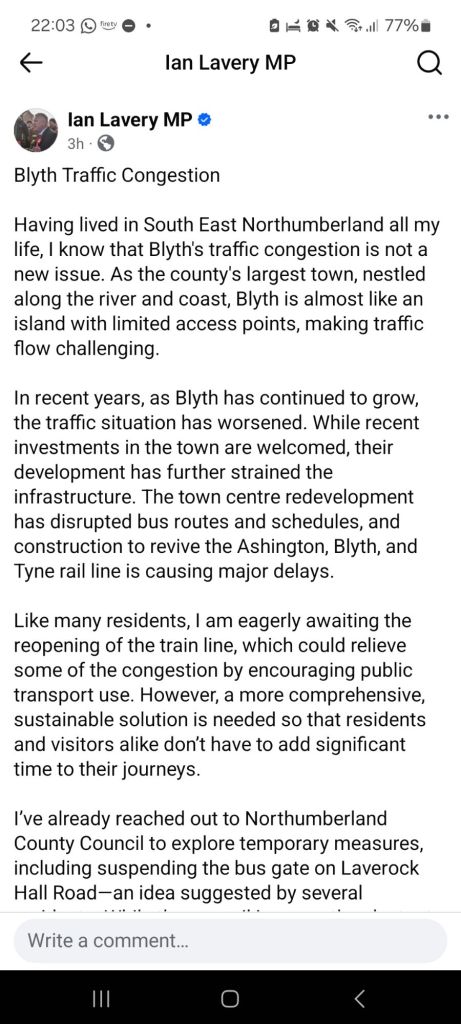
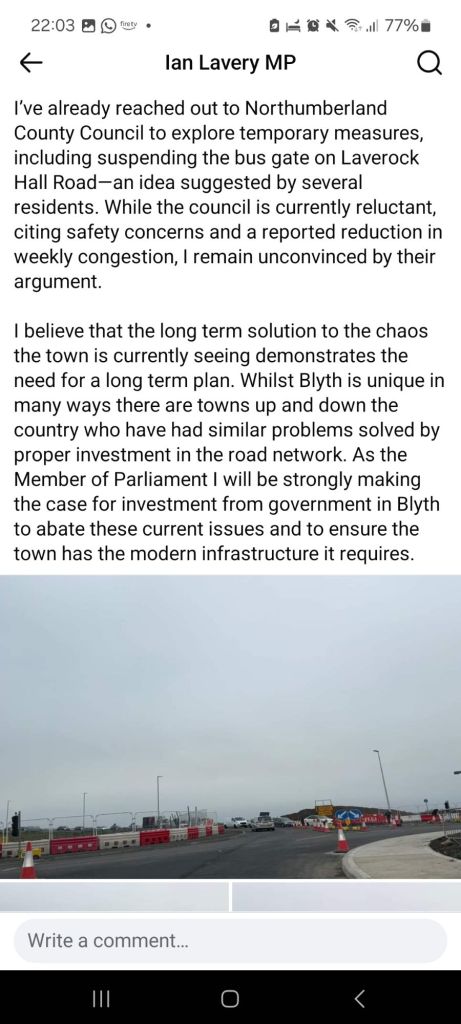
The problem, the high volumes of vehicles that enter and leave Blyth daily will hopefully be partially abated by the soon to reopen Northumberland Line (Newcastle – Ashington Rail Link), but as Ian Lavery has stated, there needs to be a wider, long term plan for transport in/out and around Blyth.
While mention is often made of a ‘relief road’, these schemes often only offer a very temporary fix, as the new capacity added is quickly consumed by additional cars and vans taking to the road and jams returning to what they were before or worse.
This is clearly illustrated by the £750,000 scheme back in 2016 to remove a set of lights where Tynedale Drive joins Cowpen Road, and junction widening, with a second phase mentioned for other work to be undertaken. In 2024 prices, this would be a little over £1,000,000 worth of work.

As we can see from the above scheme, any benefit to reducing congestion has now almost certainly been consumed by the growth in traffic since 2016, with likely few schemes possible without massive disruption.
Bring Back the Blyth Ferry?
While the town of Blyth is somewhat constrained by the River Blyth, forming a natural barrier to the north, it isn’t just an ordinary river, but a thriving small port, maintained for navigation.
Historically, there have been ferries across the river for decades, so given the scale of traffic issues, perhaps reinstating a ferry service across the port could be a fairly simple fix; turning a barrier to traffic into a new gateway to & from Blyth? The last ferry ran as late as 1997, when Blyth was at quite an economic low point, but now it is reviving, maybe the ferry could return to serve the town?
A good local example of the effectiveness of ferries is the Shields Ferry, which has operated for decades across the River Tyne, with the Pride of the Tyne, built at Swan Hunter in 1993, having served for a little over 30 years.
The most recently bought ferry, the Spirit of the Tyne, cost £1.9m when it entered service in 2007 (approx £3.1m in September 2024 prices). Given that the Shields Ferry manages to carry half a million passengers a year, a new Blyth ferry service could make a major dent into Blyth traffic.
While new landings would need to be built; (£8.8m for new North Shields landing in 2021 prices, about £10.6m in Sep 24 prices) this cost probably would be much lower than schemes such as dualling the A1061, with the recently built road over rail bridge at Newsham alone costing about £30m.
All in all, two landings, and two ferries could be potentially be delivered for less than £30m, with little to no disturbance on existing major routes; giving a real relief to the town while being almost painless in being constructed, not subjecting residents to more disruption and delay.
Assuming the Blyth landing is in the Quayside area, this would offer an easy Town Centre location to catch the ferry (presumably for foot/cycle traffic only), with a sailing time of mere minutes to reach the other side of the river.
On the Cambois side, and assuming a location near North Blyth Club, the existing 434 bus service takes only 8mins to travel from there to the Clayton Arms (next to soon to open Bedlington Station), and there would also be the option in the longer term to open up the North Blyth branch to passenger trains, which would mean a short walk between the ferry and a station in the area near Worsdell Street, and having the advantage of direct travel from North Blyth to places like Central Station or beyond.
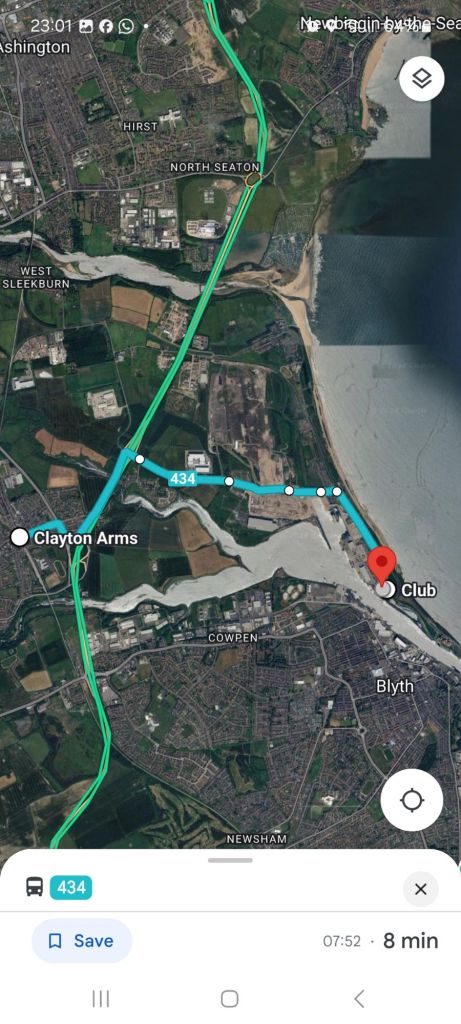
As an established local operator, Nexus could operate a new Blyth ferry if this was decided upon as an option, and would fit well with the integrated ticketing on the Northumberland Line, with it in effect being a part of the Metro network, a ferry plus the bus link could be added into that ticketing system, meaning a fully integrated trip from Blyth Quayside to Newcastle or similar via North Blyth?
 Ryan Hogg