I was inspired to write this post following a short video by Richard J Murphy titled ‘I use social media to change things‘. His content as an expert in his field is well worth watching, and should be in everyones subscription list in my view!
One phrase in the video really grabbed me; ‘I identified a problem, noted it’s cause, and proposed a solution.’ (3 minutes into the video).
This would also be true for myself, but on a transport front as an interested layman, though the two worlds overlap in places substantially in places. The problem that I have identified is car-centric thinking in transport in my local area, which is a huge problem on many fronts.
Again like Richard, this isn’t for any ego-inflating reason, if anything, advocating for fewer cars, not building roads etc isn’t a popular move. The reason I persist in doing this, like Richard does in his field, is to make the world a better place, particularly for my children.
Identifying the Problem
I have argued against schemes such as dualling the A1 in Northumberland because it presents a number of massive issues; as a father of two, I can see the damage this scheme will bring both locally in terms of higher traffic and more car dependence in places already saturated with cars at peak times, but also at a global level in terms of climate change, which puts them, like all children at risk of inheriting a world that cannot support them as it did myself.
At a local level, building more roads, and enabling more car-centric development (i.e. out of town businesses parks etc) just adds to pressures already shown elsewhere.
Take for example Seahouses, a beautiful village on the Northumberland Coast, but one that is ‘one car away from gridlock’ by this recent article in the Chronicle.
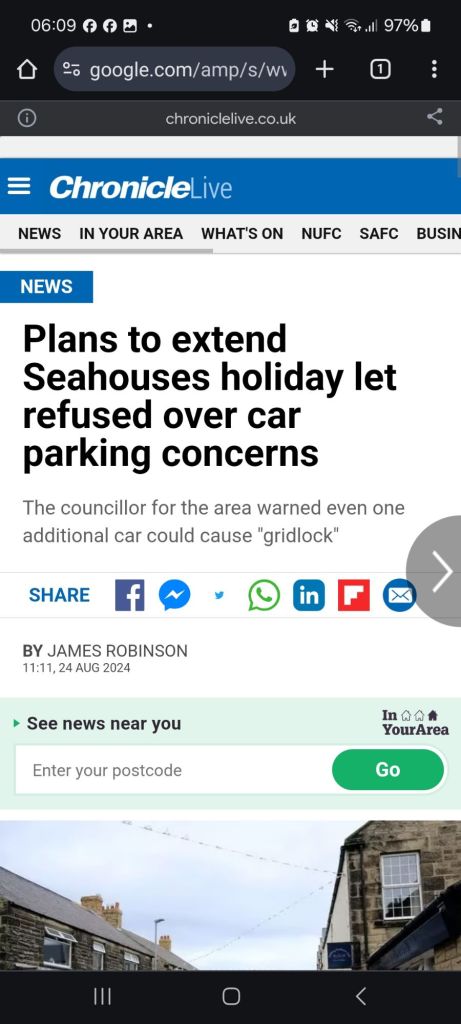
The conversion of a single room from a gym to a bedroom was heavily opposed as it might bring one additional car to the village, and it might overwhelm the existing car parks in the town too, or cause chaos in the old part of the village with narrow streets where parking blocks the road.
It is simple logic that widening a road will bring more cars, and thus put more pressure on existing car parking, which by most accounts is already at or near capacity in most places that are popular.
In towns such as Seahouses, Alnwick and more, you can’t reasonably provide more parking without demolition of buildings. In Alnwick, for example, the relatively new Howling Lane car park is on the site of the now demolished Duchess’s Community High School.
What else would be swept away to expand car parking, or do we collectively accept that the solution is better active travel routes (walking, cycling etc) for local travel (i.e. home or hotel to town centre), and for longer distances better public transport (bus and rail)?
At an global level, every tonne of CO2 has an increasing effect, the A1 as just a single example is forecast to emit 1.44m tonnes over 60 years, and the UK is historically one of the worlds biggest emitters, and almost all of our past emissions are still having an effect in the atmosphere. We can’t point at anyone else saying ‘they emit more than we do now’, as it ignores the inconvenient truth that as perhaps the first major industrial nation we are more responsible than most.
We can’t un-burn the coal, oil and gas of the past, but we can slow down or stop burning more in the future, and lead the world by example, all while making local places better to live, work and play in.
Noting the Cause
The problem is more a deep-rooted ‘car brain’ with videos such as ‘Carspiracy – you’ll never see the world the same again‘ being an excellent example of how this ‘car brain’ is so damaging to our health and environment.
The problem isn’t developments such as new bedrooms being added to buildings, new hotels, or other businesses, it is that many can’t see beyond a car bonnet when it comes to transport, and results in the flawed, automatic assumption that one more bedroom, one more hotel room etc will bring more cars, when it doesn’t have to.
Offering the Solution
The only realistic solution to problems like parking, road congestion, pollution and more from cars and wider road transport is to provide viable alternatives to driving.
In the coastal region of Northumberland, with long distances between towns, let alone major cities such as Newcastle, this means major investment into public transport. The area is already served by the East Coast Main Line (ECML) but could benefit from enhancing the services, more local trains to smaller stations like Chathill, Acklington, Widdrington and Pegswood, more semi-fast services to Berwick and Alnmouth, and more routes such as the Northumberland Coast Loop, and reinstating lines like the Alnwick Branch to connect larger, popular towns such as Alnwick back onto the rail network.
The overlap in mine and Richard’s world’s is primarily with government financing, as I understand what Richard is saying, there isn’t a ‘fiscal black hole’ as Rachael Reeves seems bent of saying, and that the ‘household finances’ model of Government spending is nonsense for want of a better word.
Let’s make things better.
 Ryan Hogg