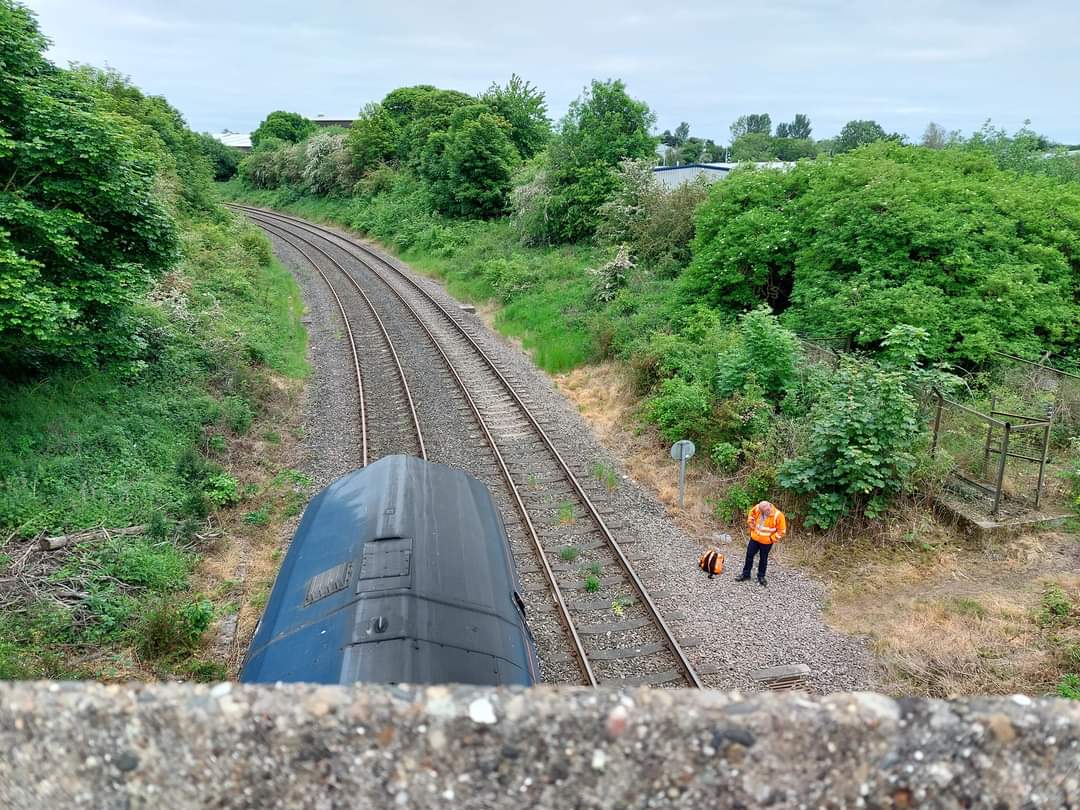
The Morpeth North Curve was actually built in the late 1970’s and completed by 1980, finally providing a direct route between Pegswood and Hepscott, rather than reversal at Morpeth.
According to Warn (1976 p.35/36) in his ‘Main Line Railways of Northumberland’ book, a curve was authorised in 1882 ‘to avoid reversing coal trains travelling from Widdrington to Blyth. Not built.
What if this curve had been built by 1890, rather than the reality of 1980? What might have been different? This is intended to be short alternative history of the East Coast Main Line and Blyth and Tyne lines.
Coals to Blyth
The original intention of the line was to avoid coals from Widdrington headed to Blyth, so assuming that the mining history (pits opening and closing at same times) then this simply would have eliminated the practice of reversal at Morpeth, perhaps resulting in smaller sidings/yards at Morpeth as this traffic would simply roll directly towards Bedlington had the chord been built.
One possible consequence of the Morpeth North Curve being built earlier could have been the effect on the development of the ports at both Amble and Blyth.
Linsley (2005) in ‘Ports and Harbours of Northumberland’, states that during the mid Victorian era, the river Tyne and to lesser extent the Wear were the prominent coal shipping rivers, with the North Eastern Railway (NER) alongside the Blyth and Tyne Railway (B&TR) largely acting to transport coal from from the Northumberland Coalfield to Tyneside for shipment.
Both Amble and Blyth had difficulties competing as the switch to larger colliers made of iron rather than wood, and with increasing tonnage increasing substantially.
Following the amaglamation of the NER & B&TR in 1874, the NER made significant investment into the port at Blyth, and exerted a lot of pressure on the harbour commissioners to continue making improvements.
Matthew White Ridley, one of the local coal owners was also an NER Director and part of the board of the harbour commissioners at Blyth, so it seems reasonable that had the north curve been built at Morpeth, the NER would have offered a very competitive rate for pits further north to ship coal via Blyth as opposed to Tyneside, borne out by the pricing policy of the NER mentioned on p. 161 of Linsley, ‘…which made shipment from Blyth cheaper than from the Tyne.’
As the improving of both Amble and Blyth were approximately contemporaneous, improvements to Blyth being on a larger scale, coupled with easier access by rail probably would have meant Amble remaining a much smaller port as improvements which already had fairly fragile financing as it happened probably would have been hit hard had the NER offered cheap shipment from Blyth.
This may have been tempered by the Broomhill Collieries Ltd, which came to own all of the pits in the area and on p. 133 that independence of the NER may have been a significant factor for this company, so Amble may still have shipped coal from these pits.
Similarly the Co-operative Wholesale Society (CWS) came to own the Shilbottle royalties in 1916 (p.134) with coal shipped from Amble. Moving coal from Shilbottle to Amble necessitated two reversals, the first where the pit branch met the mainline south of Alnmouth, and again at Chevington to reach Amble; had a direct link existed at Morpeth, this would have reduced to just one reversal on the mainline.
The later moves of the Central Electricity Generating Board (CEGB) also meant a shift to Blyth happened anyway for Shilbottle coals as vessels to supply power stations moved to 4000t colliers which were too big for Amble, with the final end of coal shipping from Amble coming in September 1969.
While it could never be a certainty that Amble wouldn’t have developed, its likely that had a direct link towards Blyth existed early enough, the economics would likely have favoured developing Blyth, with Amble remaining little improved and probably not becoming a coal shipping port or one much less than it ultimately became in reality.
Peculiarly late addition
One thing that is striking in many ways is the timing of the construction of the Morpeth North Curve, with final construction happening in the late 70’s, a time of particularly low ebb for the rail network.
This is partially explained by the development of major opencast sites in late 70’s and early 80’s which fed the Port of Blyth and Blyth Power Station, however, given the relative wealth and dominance of the NER pre-WW1, quite why the Morpeth North Curve was proposed but not built at that time is perhaps an avenue for further research?
Part 2 of this ‘What if…?’ alternative history will look at possible passenger services that might have existed had the Morpeth Curve been built at around 1890 rather than 1980.
 Ryan Hogg
One thought on “What if the Morpeth North Curve had been built by the Victorians? Part 1”