All of the below is purely my own opinions and doesn’t reflect that of any other organisations or persons.
The ‘Northumberland Loop’ refers to the Blyth and Tyne lines north of Newcastle Upon Tyne that runs northward to Bedlington, Northumberland then west towards Morpeth and Pegswood.
The Loop name is derived from the Northumberland Line which is presently reopening/creating six stations between Newcastle and Ashington, with the Northumberland Loop route taking in 5 of the 6, only omitting Ashington due to its location away from the through route.
The Northumberland Loop has been mooted before to give more direct connectivity between North Tyneside and South East Northumberland to Scotland and North Northumberland, but the recent events at Plessey Viaduct have shown a desireable benefit of it also for diversions which routine service could help maintain availability of.
The Problem
On Sunday 8th October 2023, news broke via social media of a parapet failure on the Plessey Viaduct that carries the East Coast Main Line (ECML) over the River Blyth and the structure lies between Cramlington and Morpeth railway stations in Northumberland. This was confirmed later by press releases, newspapers, radio and TV several hours and into following days.
At time of writing, the cause of this failure has not been made public, and I do not wish to speculate here; that is for official investigation and reporting by bodies such as the RAIB, we’ll know for definite in course of time.
However, the result of this structural failure was to reduce the number of lines across the viaduct from two to one – so instead of one line per direction, the northbound (down line) has had to be shared by trains travelling in both directions. This has meant an overall reduction in the number of services able to run as the capacity of the ECML has been restricted temporarily and stations such as Morpeth and Cramlington using bus replacement services in the main.
In many ways the structural issues are fortunate to have been relatively minor in nature (just the parapet wall as of now) but show the risks of a major route being severed. While you cannot duplicate every route locally, in this location an alternative route does already exist (The Northumberland Loop) and arguably could be used better to cope with potential issues on stretch of mainline it bypasses.
There has been much mention online of using the Northumberland Loop route (Pegswood to Newcastle via Bedlington) for diversions, but this perhaps is not as simple as it first appears, but there might be a solution to that which I hope to explore here.
Flying Scotsman taking the Northumberland Loop
Recently (11.10.23), the Flying Scotsman (F.S.) took the ‘Northumberland Loop’ route from North Northumberland and through Pegswood, before curving eastwards towards Bedlington (using Morpeth North Curve presumably), passing through Newsham and then on towards Newcastle via Northumberland Park towing two support carriages with it.
The reason for the inclusion of this run is to illustrate the issues underlying the (lack) of use of routes such as the Northumberland Loop as a diversionary route, but also the potential fixes to it.
Scotsman’s run was likely done to relieve pressure of ‘pathing’ the train over Plessey Viaduct due to single line working currently at play – getting trains through quickly is vital to minimise delays and steam is comparatively slow compared to most modern units with speeds very limited in comparison.
A ‘path’ is a slot in the timetable that a train can use to get from A to B, and has to factor in its maximum speeds, where it’ll stop (in case of F.S., a max speed of about 75mph, stopping if it needs coal/water etc) – this is usually worked out well in advance by timetable planners though emergency additions/alterations can be done if needed.
While the physical route existing and a path being possible would appear then to be simply a case of driving an alternative route; with railway operations it isn’t quite as simple a task, with a few additional considerations to think about.
To take any route, train drivers need ‘route knowledge’, essentially this is thorough knowledge of the stretch of railway in terms of speed limits, gradients (line heading uphill/downhill), where features like bridges, tunnels, level crossings etc are and the signalling that controls their movements.
This is important as the driving characteristics of trains are quite different to a road vehicle, you cannot just suddenly stop at a red (danger) signal as you can in a car, especially at any reasonable speeds where there is a risk of simply sliding if braking too heavily, then overrunning a red signal (SPAD) could result in a derailment or crash (as passing through a red light could result in road collision).
It’s not too dissimilar to driving – a regular route is familiar in bright daylight, darkness, rain, snow etc. but a rare or new road might catch you out – in a car its much easier to respond ‘on the hoof’ but with a train it could well be too late to stop if travelling too quickly which is why drivers need to be highly trained and familiar with the route they are driving on. Hundreds or perhaps a thousand tons plus doesn’t just stop!
To ‘sign’ a route (to confirm their knowledge is sufficient to safely drive it) means drivers having to study and practise driving it repeatedly and then they’ll be assessed on it and only then allowed to drive it solo.
Importantly this is also not a ‘forever’ pass – it needs be kept fresh for any signalling/route changes and as far as I understand route knowledge would expire after a certain length of time.
However, you then also need to consider the ‘route clearance’ of locomotives, carriages, and waggons – parts of the UK rail network have oddities like low bridges and tunnels, weight restrictions or tight curves; so vehicles themselves must also be cleared for the route too as obviously damage could be caused if a heavy locomotive was sent over a weak bridge.
Another consideration is ‘signing the traction’ – different types of train have different controls, systems and behaviours that also need to be learnt; Locomotion is a very different loco to Flying Scotsman despite both being steam engines and drivers would need time and training to familiarise themselves with driving each one.
For Flying Scotsman, the route clearance has long been established (has run railtours over route before), drivers either have knowledge already (usually drivers are from specific railtour operators and/or drive freight trains so may hold a wide route knowledge), so taking F.S. around this route likely wasn’t a major problem beyond finding or creating a path for it to run.
It does show the complexities – a driver may know their loco (F.S. for example), but if they don’t have route knowledge it can’t be driven there (unless some form of pilot working is established with another driver giving instructions) and for rolling stock to be cleared for the route (which must be done in advance).
The Northumberland Loop – Regular Running to build and maintain route use
As a route used mainly for freight, and with the odd railtour (steam or diesel) in amongst that, then the pool of drivers who sign the route will likely be a fairly small number compared to the number that sign the ECML between Newcastle and Berwick.
This is understandable – its a much busier route so more drivers are needed, and very few passenger trains have ran on the lines around Bedlington until fairly recently as the ‘Northumberland Line’ has begun to take shape and Northern Rail has ran some special trains along the route and helping start route learning to build route knowledge.
Northumberland Loop – Long Distance services
One issue is that many (but certainly not all) trains on the ECML are electric, which for obvious reasons can’t run over the lines via Bedlington as they lack overhead wires (for now) – it is possible to ‘drag’ electric trains using a diesel ‘Thunderbird’ (after the classic TV show) in desperate circumstances but is far from ideal as it requires a suitable diesel locomotive, and adds a lot of complexity so isn’t an everyday solution.
However, a number of long-distance diesel only or bi-mode (diesel + electric) trains do run between Newcastle and Berwick and running even a few of these via Bedlington rather than Cramlington would help develop the pool of drivers who sign the route, rolling stock that is route cleared whilst also providing a useful connection for passengers travelling to/from the North.
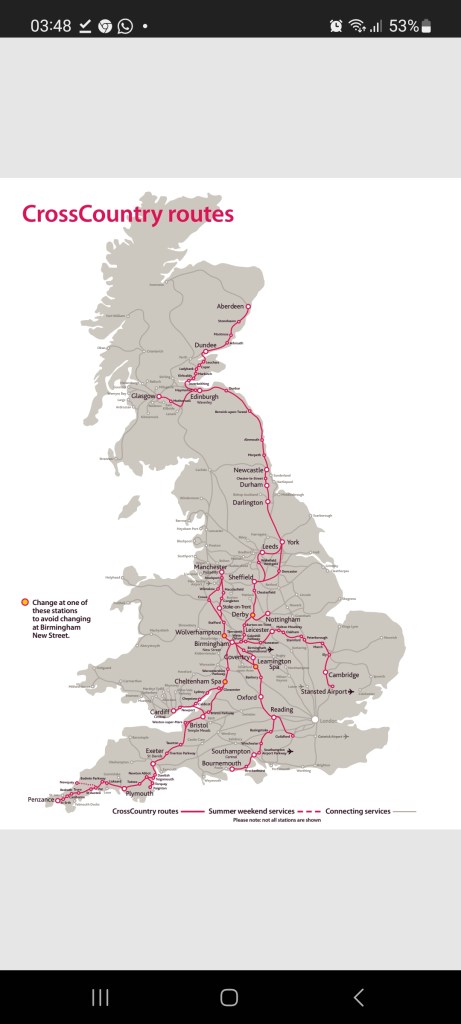
For example, CrossCountry trains uses mostly diesel Voyagers for its services as many routes are non-electrified, and as can be seen from above map, there are several ‘loops’ in present services around Leeds/Doncaster, Crewe/Congleton, Coventry and Weston-Super-Mare. As far as I am aware, these units have not used the route before so would need to be cleared for it.
Could running via the Northumberland Loop, taking in Northumberland Park (for wider North Tyneside) and Bebside (for Blyth, Cramlington and Bedlington) and Pegswood (for Morpeth and Ashington) be a good option for CrossCountry? It would directly serve much more populated areas while still being reasonably close to Morpeth (served via Pegswood), and could help maintain passenger driver knowledge for use during periods of engineering disruption (i.e. other drivers could shadow in cab between Newcastle to Alnmouth to keep up route knowledge).
This would slightly lengthen overall journey times (Newcastle to Pegswood via Cramlington approx 18/20mins, via Bedlington approx 35/40mins [would need further investigation]), but 20mins is a very modest change compared to route via Durham Coast (which could also be valid route for CrossCountry), but might also be an option to extend an operator such as Grand Central north of Newcastle via Bedlington – which would fill a missing link of direct trains between Scotland and the Durham Coast via the Northumberland Coast.
However as four coach units, they should be able to call at Northumberland Line/Loop stations with no issues so could be an easy service to introduce in that respect.
Northumberland Loop – Local Services
The other issue that the Plessey Viaduct issues have shown is the short-term disappearance of local services operated by Northern.
For example the Newcastle to Morpeth Northern Rail services have largely been replaced by buses, but if services also arrived/departed Morpeth from the east (arriving into/departing from a rebuilt Morpeth Bay) then it could offer an alternative rail connection via Blyth – either as mainline trains direct to Newcastle (and perhaps beyond), or potentially as a Tyne and Wear Metro extension to serve Morpeth (Metro to Morpeth).
This could work happily alongside the proposed extension of Newcastle to Morpeth services to Bedlington (Bebside may be possible but likely to require a turnback facility).
Electrification of the Northumberland Loop
As stated earlier, one limiting factor is that the Northumberland Loop is not wired at 25kV AC, which would allow electric trains running on the ECML currently to divert as and when needed via Bedlington. There are higher priorities for wiring elsewhere in UK but this should be the desired standard to be delivered as soon as practicable, as it has wider benefit in then making wiring rest of Northumberland Line (i.e. to Ashington/Newbiggin and North Blyth) more reasonable to decarbonise local trains and esp railfreight.
In the event of ‘Metro to Morpeth’, it may be either be done under battery power (most likely in short-term) or units becoming dual voltage (mix of 1500v DV and 25kV AC, with other Stadler produced units being dual voltage this shouldn’t present a massive issue to retrofit to Class 555, and again wider benefits on other routes (Pelaw-Sunderland, Leamside Line etc).
If you think these proposals are a good fit, please take a look at my petition which helps gauge the support for the proposal. https://www.change.org/p/create-the-northumberland-loop-rail-services-from-berwick-to-newcastle-via-blyth?fbclid=IwAR0NScuxcxM1mW7psxa0xjOZSYY9snOcCZsyaEw068_heBLPaHcQ1XBSfDA
If you’d like to further support this, please write/email to your local councillors, MP, rail campaigns etc.
Thanks for reading and feel free to leave any feedback!
 Ryan Hogg